The Safari is pleased/relieved to report that our Purple Sandpiper pics we posted in our challenge the other day did pass the adjudicator's deliberations in that 'hand of man' wasn't discernible in the pic and had we not owned up Monika wouldn't have known. So far there gave been two calamities for other challengers, one lass couldn't submit her Snowy Owl up in the Skagit Valley as it was sat on a fence and 'didn't budge all the time she was there' and Monika herself missed out on a Northern Shrike, another seen on a fence only bird. In fact the challenge is becoming quite challenging trying to make sure there's no 'hand of man' in the photos.
We also forgot to post our Black Tailed Godwit in the fog pic for number 57 but it's OK as at the end of last week we were able to get better pics in half decent light at 'The place we do not mention by name' on the Southside when we had a safari out there with CR and met up with JG for a day's birding and chat.
The previous day had seen us back on the North Blackpool Pond Trail doing a bit of volunteering - bit being the operative word!.
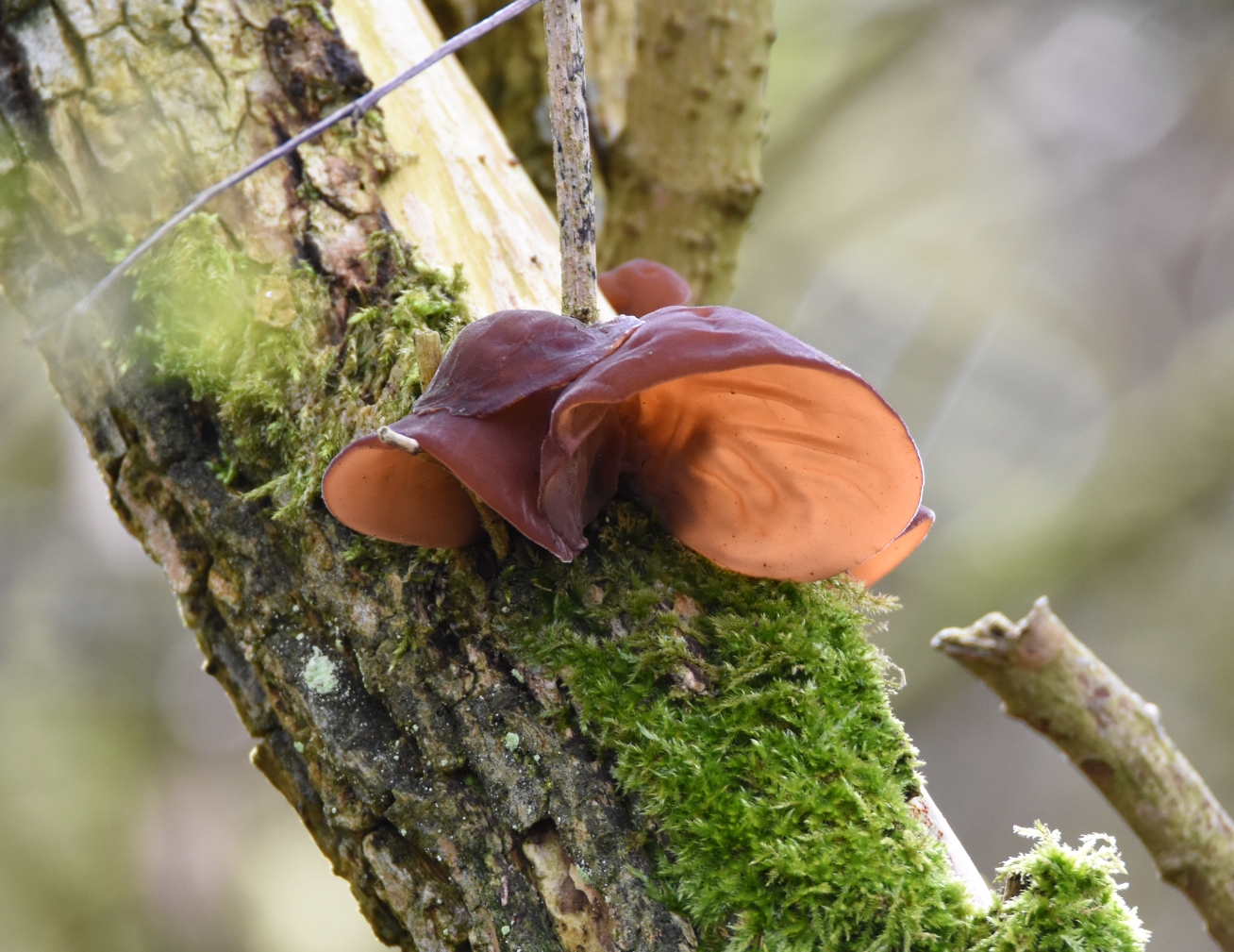
The project was to clear some fallen Willow which was beginning to encroach on the edge of the path. So armed with a pair of loppers and a bowsaw we set to on one of the smaller branches. Once we'd cleared a way in through the outer twiggery with the loppers we spotted a few blobs of what looked like little bots of Orange peel on a couple of the stouter branches. Closer inspection showed it to be - we think - Yellow Brain fungus.
 |
| The white bits aren't icing sugar but the remnants of the early morning frost which the sun hadn't reached deep in the gloom of the overhanging branches |
Now us volunteers were able to make big in-roads in to the branches of the Willow trees but our saws weren't big enough to tackle the larger trunks so out came the chainsaw. And that was our cue to go for a little wander as Monty doesn't like being in close proximity to the noise of power tools, and who can blame him.
The main lake was still mostly frozen, in the shelter of the overhanging trees around one of the island there were 10 Teal and three Shovelers sheltering but sat right out on the ice was this Heron.

Once we heard the chainsaw stop we returned to the work-party and get stuck in trimming up some of the branches we'd cut earlier ready for them to be dragged off to make a dead hedge and habitat piles deep in the woods. After a while the chainsaw needed to come out again so off we went for another lap of the lake. This time the Heron was found at the very edge of the pond at the viewing area and was sat just behind the fence as it often does - it's almost tame.

Further round we came across a Greenfinch singing high in a treetop. Just out of range for the smaller lens we take when we're volunteering but it's still identifiable so goes on our challenge tally at number 58, we'll try to get a closer, sharper one in due course.

By now everything had been cut up and all the brash needed dragging to the piles in the wood. Not sure if Monty was helping or hindering though but he's always eager to carry a stick.

Lunchtime came around and with it our cores back at Base Camp beckoned so we had to call it a day and leave the remained of the cut brash to the rest of the gang to manhandle.
As we mentioned earlier Friday saw us on safari to - well you know where. JG had found some odd sea-shells on her local stretch of beach and wasn't sure what they might have been so had collected a sample for us to pass on to our marine biologist friends for an ID and some info about them. A good excuse to meet up for a Southside safari.
As ever the new hide - which has been there a few years now - was busy with birds just outside the window and we soon got our replacement photos for the foggy Black Tailed Godwit. If our Warton Bank pic was taken from about 40 yards, here the godwits are less than 40 feet away!


which then developed into a full blown fight, neither bird giving any quarter as they fenced like a couple of swashbuckling musketeers


Perhaps we should have video'd the fight as we promised we were going to do some YouTubing - that idea seems to have fallen by the wayside already. The video would have had the advantage of sound as there was a lot of 'wickering' going on while they were bickering. We chose one of the action shots and this time did remember to add it to our challenge, the previously forgotten number 57.
There was plenty of other birds to point the lens at too.
In the previous years' challenges we've posted drake Pochards so to get a good view of a beautifully subtly marked female of this ever decreasing species was a bonus. 59.

 |
| Hmmm not brilliant |
 |
| Hmm, a nicely marked individual but similar to previous years pics and not as close |
 |
| Hmm not pin-sharp but tht's a good action pose so number 60 it is |
After filling our waterfowl boots we moved on to the feeding station at the Kingfisher Hide where there was some nice light. Unfortunately we kept missing the Greenfinches when they perched ever so briefly on the shrubs the feeders hung from so we were unable to get a better challenge pic, this nicely illuminated one isn't allowed.


Behind the hide, above the path, there are a couple of Tawny Owls - if you can find them! After about five minutes hard searching we did spot one lurking high in an Ivy covered Silver Birch tree but no matter where we stood we couldn't see its face. Still counts though, number 62. Believe it or not it was the talons gripping the branch that we spotted first to give it away!

From the Ron Barker Hide there were few birds and they were mostly quite a long way off. We had a quick cold look at the Teal to see if the sometimes seen Green Winged Teal, was about - as far as we could tell it wasn't and we soon closed the window to keep the icy wind out. News was that the formerly regular Kingfisher was now the very occasional Kingfisher in the dyke in front of us so we made do with a pic of the reserve's bull stood right on the far side of its field but there were no Barn Owls flying around between us and him, apparently there had been earlier in the morning.

We didn't stay long in the hide and replaced our steps back to the Tawny Owl, good job we did as this time we did find, just about, a gap through the leaves almost big enough to show most of its face.

Time to spend sometime on the other side of the reserve. The old Swan Link Hide has better light than its new counterpart, the Lapwings in particular were looking rather dapper. 63.

There's not so many Whooper Swans around this year, still plenty like over 1000 but news on the street is there are still plenty unmigrated (is that a word?) in Iceland.

Close-up portraits are available too, not often you can get this close to this normally shy and wary species. 64.

Another shy and wary species as also coming so close that it would only just about fit in the frame, a Jackdaw, 65, was working its way back and forth along the water's edge. We don't know what it was as in all the time we were watching it it didn't pick anything up, it was definitely looking for something in particular.

The second feeding station was lively mostly with Goldfinches and Chaffinches but no sign of the hoped for Brambling that everyone was on the look out for.
 |
| Goldfinch, 66 |

So we had to make do with a nice little group of male Chaffinches instead, maybe one for replacing later but we quite like it so maybe not.

A busy little party of Long Tailed Tits came in too, very lively and hard to get a clear shot of as they worked their way through the foliage to the feeders. We only managed to get one decentish pic to post at number 67.

We would have preferred this one - if only our shutter speed had been set a bit faster and the bird stayed within the depth of field instead of coming slightly towards us - jeez some folk are never happy!

Butties were munched while we were enjoying the activity around the feeders, a lively feeding station is always a joy to sit quietly and watch just taking in the action. Once lunch was over we moved on again having a look at another Tawny Owl location just inside the ornamental grounds without success and stopping only briefly at the Harrier Hide where the light was poor and there was little on view save for a few Gadwall and Teal anyway. Next up was the United Utilities Hide where reports suggested the Kingfisher was most likely to be seen these days. We had to use the upstairs viewing area as the hedge has grown so much it now obscures much of the view from the lower deck and will do so more come spring and new leaves - which we saw only a few feet away on a Hawthorn bush along the path to the tide - already! A bit of hedge laying is required between now and then we think.
from the top deck there's a good view of the grazing marshes and main mere but everything was a bit distant, the only thing to come almost close was a fly-by Cormorant, 68.
One of the further fields held a flock of Grey Lag Geese which we began to peruse to see if there were any tardy Pink Footed Geese with them, almost all of those leave the reserve during the day only retuerning to roost for the night but there's often a few that have been injured by the wildfowlers and less able or even unable to fly kicking about. It was while checking through the Grey Lags that we saw some movement on our side of the ditch in front of the flock, a couple of Brown Hares, very nice to see as we always seem to rue thhe fact we never see any large mammals appart from the herd of (conservation grazing) Longhorn Cattle here, not that Brown Hares are large but a Roe Deer or even a Red Deer or the occassional Wild Boar wouldn't go amiss on the odd visit. Nearest we've got is a buck Fallow Deer approaching the reserve from the farmland behind the Ron Barker Hide a few years ago.

 |
| Gremlin ears lol |

By now it was getting near time for the afternoon swan feed spectacle so we made our way back to the Discovery Hide to wait for the Ranger to appear wit ha barrow-load of grain for the eagerly awaiting waterfowl, many of which had already got themselves into prime positions. That is until someone else wants your prime position. We think that's what happen with these Pintails. The male and a duck were sitting together quietly on the bank having a bit of snooze before the food arrived when a second female left the water, walked up the bank and promptly laid into the drake.

his female wander off Stage Right while he was having none of the interruption and fought back

At one stage it looked as if aggression might have turned into hanky-panky

But the duck shifted her position and drove the drake into the water. After the action had settled down we noticed that original duck was still stood a few feet away apparently unconcerned with all the argy-bargy but loking closely at her we saw she was ringed.
 |
| There's more there than H0010 |
So as she moved around a bit we tried to get some more pics to fill in the blanks but could only manage to get a decent pic of the opposite side of the ring and that wasn't conclusive.

After a brief Twitter conversation with WWT's KB it would appear that the first digit must be F and the last could be/probably is 9 making FH00109, a female Pintail ringed at Martin Mere on 31/10/2018
The Ranger appeared the food went down and the melee began. Shelducks began to fly in from all corners giving us the opportunity to get exactly the same pic fro our challenge as last year possibly from exactly the same seat too! 70 - must try to get something a little different soon!


No news on this one yet we'll keep you posted...
With daylight drawing to a close we decided to leave a little earlier than normal and try our luck with the local Little Owl not far from the reserve - it wasn't sat on its favourite barn roof today, better luck next time as we headed back to Base Camp.
In other news we've been enjoying a bit of snow, good views of the planets Venus, Jupiter, and very big star Antares and the almost twice the size of our sun Sirius when the skies have been clear and have spotted another Fox (could well have been the same one as the other day in a different place only a short Foxy saunter from where we saw it last time).
Where to next? Sorely tempted by the Blyth's Reed Warbler an hour or so down the road, off that way tomorrow but will be indoors all day. Let's hope the bird survives the up-coming cold weather and we can get down there on a sunny day when it's feeding actively.
In the meantime let us know who's got all the brains, yellow or otherwise, in your outback.