Showing posts with label Andrena. Show all posts

Monday, 4 May 2020

Lockdown week 6 brings a little belter to the garden

The Safari was struggling with the poor weather early in the week especially in the garden. On Monday only a Buzzard low over the chimney pots made it into the garden notebook and Tuesday's only entry was of a Blue Tit collecting dog hair for its nest again. We made no further entries until Sunday! The camera didn't see much action most of the week either.
Highlight of Day 1 was four high flying Whimbrels heading seawards early morning and a few minutes later a Sparrowhawk flew across the main road heading to the park with prey in its talons. 
On our exercise walk round the park - about a dozen times - we had a Whitethroat and Lesser Whitethroat on the rough field but otherwise it was quiet.
Tuesday was a bit of a better day and we took our exercise walk the other way along the North Blackpool Pond Trail. It was lively enough.  Pick of the bunch were two Lesser Whitethroats, three Whitethroats and a showy Sedge Warbler but we hadn't taken the camera - dohhhh. A shed load of butterflies too, don't think we've ever seen so many Orange Tips in one place in Blackpool before, we also got our first Speckled Woods of the year too.
A modicum of excitement was had in the garden when a female Blackbird dropped in for a quick dip in our little waterfall. It was very wary keeping tabs on us as we raised the camera cautiously from behind the kitchen window's blinds.
The following day we had another change of scenery with a visit to the prom. It was cold and blustery with very little on offer either out to sea or along the cliffs. Out to sea was marginally better half a dozen Gannets and a male Eider versus a couple of flighty Wheatears along the cliffs.
We were back there again on Thursday, not entirely sure why it was always going to be pretty dire. Easily the best sighting was of four Gannets diving for fish just beyond the low tide water's edge, four Sandwich Terns were there too. Again no camera but they would have been too distant anyway. Along the cliffs we had another Wheatear and a Swallow heading north as well as one in the side street where they nested last year.
May arrived on Friday and once again we were up at the cliffs. Slightly better today with a flock of 11 Gannets followed by a few others. On the return leg we stopped for a scan and hit a bit of jackpot - way out on the horizon we spotted the unmistakable cruciform shapes of careening Manx Shearwaters. In the few minutes we stood watching we counted over 50, there could have been many more out there we couldn't see with just our bins.
In the afternoon we broke the rules a bit and went out again with Wifey and the mutt, we made sure we kept well away from anyone else, we prefer five metres rather than two anyway. This time we went up to the North Blackpool Pond Trail and came across our first brood of cutesy Mallard chicks.
A Robin was 'cock of the rock' singing from the top of the tallest tree in the area. We didn't have much opportunity to point the camera at anything else but as you can see from the colour of the sky it was a very pleasant hour out.
Saturday saw us having an earlier start down at the park. Not taking our phone was a mistake as when we got back to Base Camp we learned we'd missed a couple of Hooded Crows only 200 hundred yards away over the road. Found by the same lad who found the Redstart we dipped for the very same reason. Once is unlucky, twice is a bad mistake, thrice is just plain stupid - there'd best not be a third time!
The afternoon was warm and sunny and saw us in the garden at Base Camp hunting down whatever invertebrates we could rummage out.
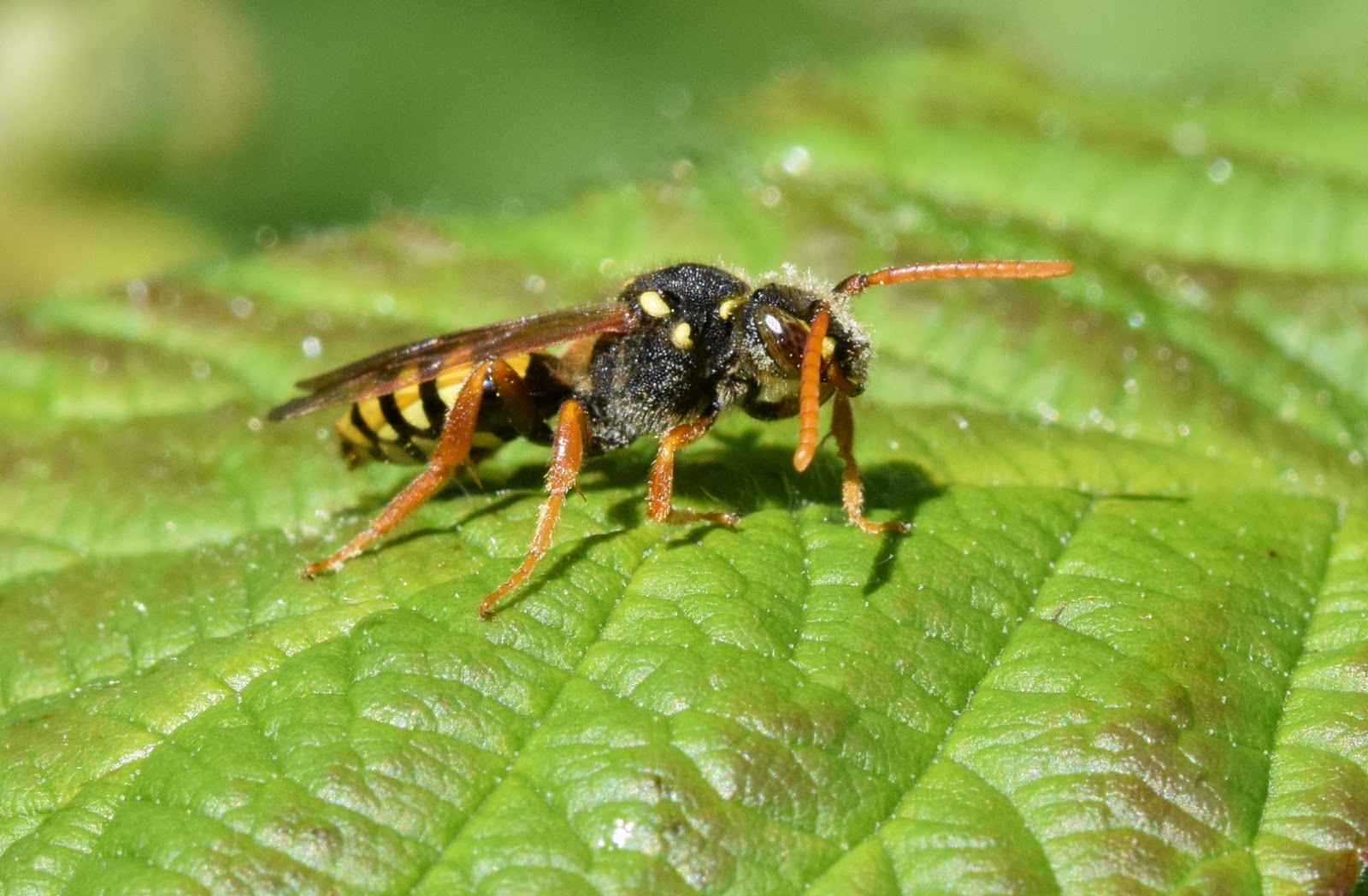
There's still a few a few Gooden's  Nomad Bees about.
While watching the bees we spotted a Green Shieldbug, then another then another, four in all.
Their underside is pretty impressive - don't think we've ever noticed it before
Also out n about were the first Honey Bees we've seen this year, that's bees plural we did see a solitary one a few days ago.
Other solitary bees included this long thin dark Andrena species - as yet unidentified. Any one got any ideas.
Much easier to identify, especially now we've got used to them, are these bonny male Blue Mason Bees.
The only bird to report wasn't seen by us but 'discovered' on a friend's Facebook page - a Cuckoo calling at the crem along the North Blackpool Pond Trail - - that'll need further investigation next week for sure. Fingers crossed it sticks around.
The morning started cool but it warmed up just before lunchtime and while out in the garden we spotted a row of faces peering out of the Bee Hotel. We dashed inside to get the camera but by the time we got back out they'd all left bar one.
Red Mason Bee checking the coast is clear before launching in to the clear blue beyond
The compost heap is a good place to watch spiders, mostly Wolf Spiders, but further inspection had us looking at a dangly thing which when we touched it the spider shot out to defend its nest or at least check it wasn't damaged by the huge lumbering oaf of a human. The dangly thing looks like it's made from a Nettle leaf, the spider is most likely to be Tetragnatha extensa, quite a beauty when inspected closely. 
In the dark so not so a bit too grainy even with the flash
The other spiders out in the light don't hang around for their pics to be taken they're always on the move.
Some looking for prey, some looking for mates.
Judging by the way this one is signalling it would rather be the latter than the former.
After getting the pic of the tiny Ichnumeon Wasp last week we've been keeping our eye out for some more. We'd seen a few tiny flies when we saw another that looked a bit different so we fired a few shots off, but without our specs couldn't really see what it was on the screen. Downloading the pics on the laptop we saw it was a beetle, indeed a Longhorn Beetle, but which? CR offered an ID Grammoptera ruficornis. Turns out to be quite a little find - emphasis on the little - not recorded in the Fylde before (or if it has it's not reached the NBN maps yet) and there is quite a big hole in Lancashire away from the Morecambe Bay limestones.
We're confident C has got the ID right but have put it on iNaturalist to see if we can get a confirmation or two. Not a bad (but very lucky) find in a small garden that's just been left a little to wilderness. 

Where to next? Lockdown continues so it'll be more close inspection of what's on offer at Base Camp and the same three walking sites where something is bound to turn up, after all it is May and anything can turn up anywhere.

In the meantime let us know who's turning up in odd places in your outback

Stay safe - stay socially distant - enjoy the wildlife on your doorstep, it's out there for you to find all you need to so is look..and have a bit of luck.


Tuesday, 4 April 2017

More spring arrivals

The Safari has been out n about recently. We've caught up with a most of the early migrant birds including a surprise, been herpetoligically challenged for a while and seen some quality solitary bees in new places.
On Friday we spotted a Tawny Mining Bee in the street at Base Camp, a first here. CR has loads in his garden only 400 yards away and offered the opportunity to come over and take some pics on Saturday but we had family duties so couldn't take him up on his kind offer. 
Sunday saw us out early picking up BD on the way to the dunes. We parked up at our favoured spot and started to cautiously inspect every square inch of the dune along the track. We soon found our first 7-Spot Ladybird of the year, but that wasn't what we were after.
Monty's keen nose sniffed at something on the road just in front of the car, we pulled him away as he's a begger for trying to eat anything and everything off the pavement but as we looked to see what it was shock and sadness overcame us - it was a freshly killed large specimen of what we'd come to look for. A Common Lizard.
How unlucky, what was it doing in the road in the shade? And a blow to the small and isolated population of them here. It may well have been killed by the car parked a little way in front of ours. 
It took a good half hour or more of intense scrutiny of the dune face to find our first live one tucked away in a small patch of dappled sunshine.
It took a while before we realised it wasn't on its own, there was a much bigger one extremely well hidden and superbly camouflaged only inches way!
Monty started getting disruptive as other dogs began to pass by on their morning walk to the beach an while we were gtetting to grips with him yet again BD shouted out he'd found a third, another tiny yearling well away from the first two. We bundled Monty into the car and went to have a look.
Tiny indeed and already missing its tail.
So three found and the dead one wasn't a bad haul if a little sad. on the way back to Base Camp we passed herpetologist supreme RL's truck parked at the roadside. A later email revealed he'd found about a dozen by 10.30 by which time he told us it had got too hot; we'd left to get back to Base Camp before our 10 am curfew.
At Base Camp we took Monty for a quick stretch before making Wifey her breakfast. It was on his little walk we spotted some solitary bees on the dry stone revetment of our neighbour's garden. You guessed it we had to go and get the camera!
They're too small for Tawny Mining Bees, the males of which have white 'moustaches' which these don't. They are a species of Andrena but which one??? 
After breakfast we were able ot get out again and this time went to the nature reserve where we met up with BD again. At the viewing platform we heard Willow Warbler (124, MMLNR #55) and Blackcap (125, MMLNR #56). B saw but couldn't get a pic of the very loud Cetti's Warbler singing in the reeds across the little pool. A Little Grebe whinneyed away in front of us too.
Moving down the main drag we had a look for the Bee Orchids but couldn't find any rosettes this time. All around us Chiffchaffs chiff-chaffed and we heard another Blackcap. Passing the scrape we stopped to look to see if any of the Teal were Garganeys, they weren't but we did hear a Reed Warbler (126, MMLNR #57) strike up its rhythmical almost mechanical song, it transpired that this was the earliest Lancashire record by a day. How long before a totally unprecedented March arrival???
A Buzzard (MMLNR #58) was temptingly in range of the lens over the embankment but by the time we'd got round there it had disappeared.
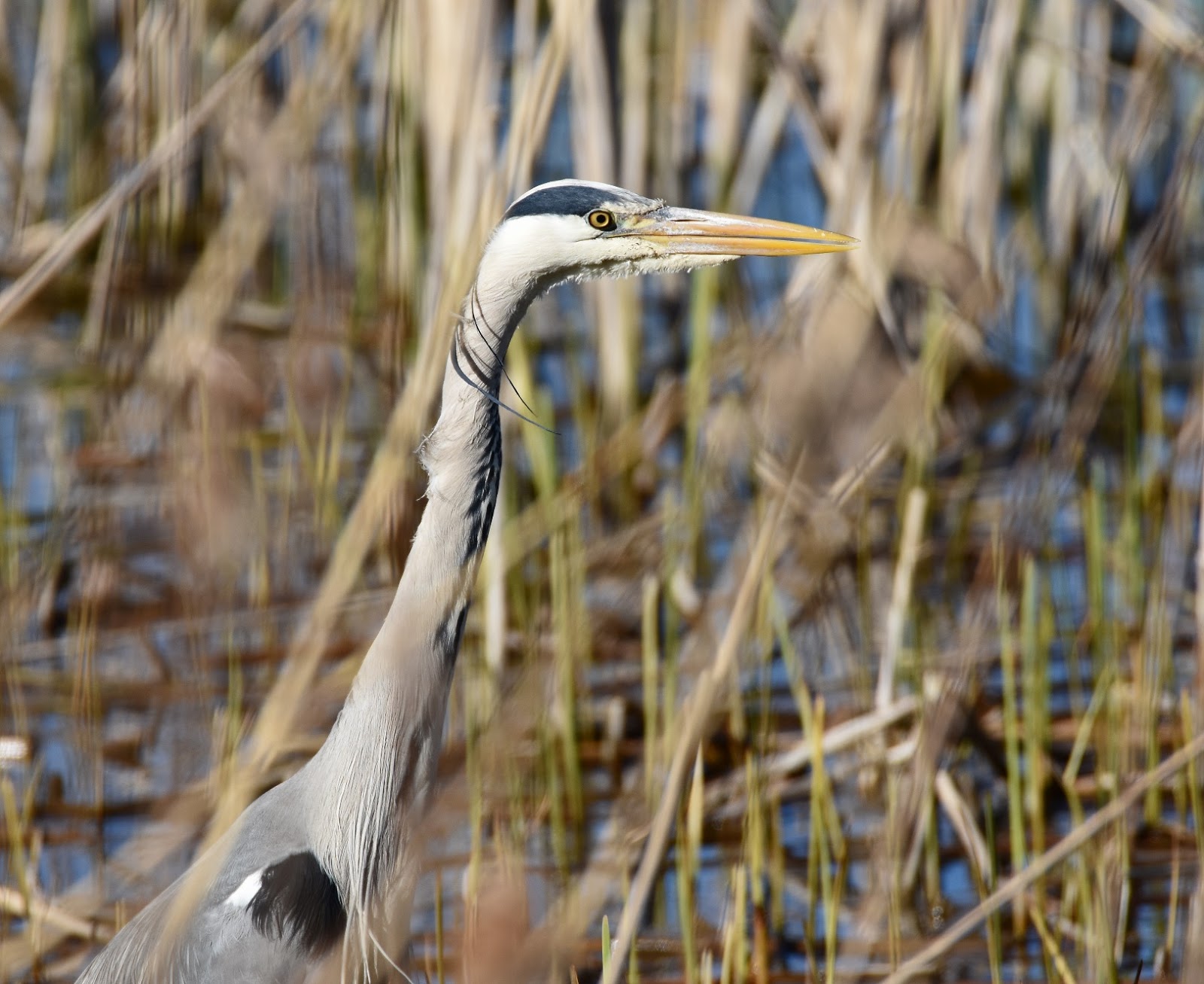
At the hide we grilled the gulls in the hope of the Iceland Gull - or better - but there were only Herring and Lesser Black Backs coming in to bathe save for a single 2nd winter Great Black Back and a lone Black Headed Gull. Again the very loud Cetti's Warbler refused to show and none of the Teal or Shovelers could be 'strung' into anything more exciting.  Two Oystercatchers (MMLNR #59) and a Lapwing (MMLNR #60) were with the waterfowl on the scrape. A Heron flew in and gave great views, not wanting to sound ungrateful but we'd have rather it had have been the Bittern.
Excitement did come a little further on when B spotted several Tawny Mining Bees in the grass. We'd have though it was a bit long for them but there they were in all they brilliant red glory.
Looks to be holding something in its jaws
We didn't stop at ICZ but did have a look at the adjacent meadow where there were a good number of Cowslips and a fair few Snakeshead Fritillaries.
Moving on to the Feeding Station we had a pleasant surprise, the Brambling (MMLNR #61) reported the previous day was still there.
The light was pretty good and the feeding station was fairly busy so we stayed a good while snapping away ad infinitum.
The Magpies were a little infuriating as they simply refused to turn so as the sun caught their iridescent plumage. It took a lot of shots to get this one...only to then see the bird has an elongated lower mandible.
Action shots always prove tricky but when they're right they're pretty impressive.
Always on the margins of the activity this Robin kept returning to a favoured perch but never stayed more than a few seconds. In the middle of winter they are far less shy getting right in the thick ofg the action on the feeders and arguing with all-comers.
There's always a Pheasant or two hoovering up spillage.
The male looked most splendid in the bright sunshine but only did his sing-whirring display under the cover of the trees, most annoying. The only time he did it in the open we missed it but he was obscured behind one the feeding table posts anyway.
Not a bad afternoon out despite the hordes of unleashed uncontrolled dogs, the idiots on the roof of the hide and the scrotes on the mini-moto bike. Must go mid-week after the holiday for a bit more peace and quiet next time!
Back on Patch 2 yesterday we our first Sandwich Terns (127, P2 #38) of the year when we saw half a dozen successfully catching small fish just behind the surf. 11 Whooper Swans (P2 #39) leaving the marshes of the estuary and pitching down on the sea about a mile out was good too. That evening we took Monty to a drier site than the mud-wallow of the park that is Patch 1 and saw our first Swallow (128) of the year tazz seaward.
Despite all this excitement we've only added one species to our Photo Challenge list, a very poorly phone-picd Jay (YBC #106) in our parent's garden, the only one we've seen there since the early 70s and the house is imminently to be sold! 
All busy busy springy stuff with more to come in the next few days. 
Where to next? Lots of desk driving at work is curtailing wildlifing opportunities to just a few minutes a day for the foreseeable but you never know! 
In the meantime let us know who's trying to get in the record books in your outback.